



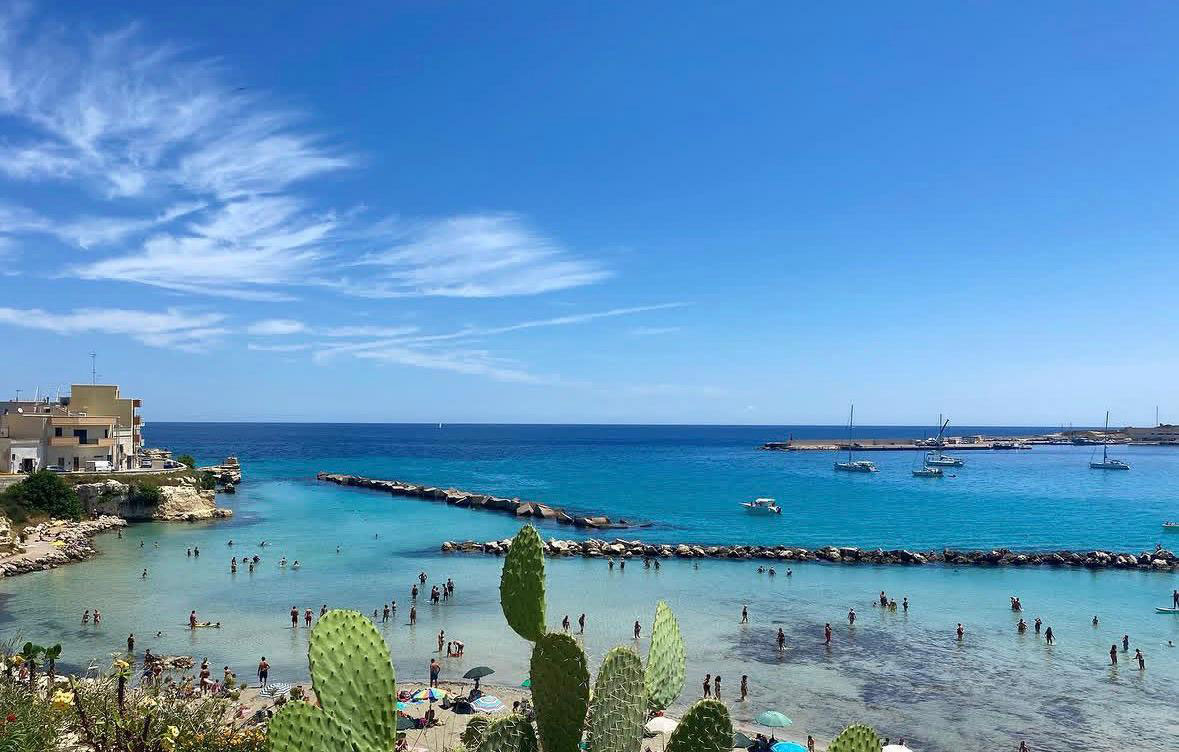
Puglia's Adriatic Coast: Why Choose Otranto for Your Holiday
When people think of Puglia, many picture the Ionian coast first: Gallipoli, Porto Cesareo and the western side of the province of Lecce, with emerald water and long sandy beaches. It is a powerful image, and with good reason. But reducing Puglia to its Ionian shore means missing something substantial - something the Adriatic side preserves with a quieter, more discreet character.
Puglia's Adriatic coast, from Brindisi down towards the tip of Italy's heel, is a succession of historic coastal towns, rocky coves, remarkably clear water and landscapes that feel unlike many other parts of the Mediterranean. It is less familiar to many visitors and, in several stretches, less crowded and more intact.
If you are deciding where to spend your holiday in Puglia, it is worth understanding what really distinguishes the two coasts.
Adriatic vs Ionian: a distinction that matters
This is more than a geographical difference. Puglia's two coastlines have very different characters, and choosing between them can shape the kind of holiday you have.
The Ionian side is associated with soft light, warm shallow water and broad, easily accessible beaches. It suits travellers who want to settle under an umbrella and spend long hours in one place. The Adriatic feels different: often breezier and cooler, with seabeds that can become deeper more quickly and water that is frequently strikingly clear. It is a kind of beauty that rewards swimmers, snorkellers and people who enjoy exploring rather than staying in one spot.
Sea colour, wind and water temperature
On the southern Adriatic coast of Puglia, the colour of the sea changes throughout the day. Early in the morning it can appear grey-green; around midday, under a high sun, it turns towards intense cobalt blue; later in the afternoon, with lower light, it takes on tones that can feel closer to the Greek coastline than to other parts of Italy.
The north-easterly grecale is common in summer. It can be a welcome source of relief on very hot days, although it is worth bearing in mind if your idea of the perfect beach day involves completely flat water.
Puglia's Adriatic coast: from Brindisi to the heel of Italy
The Adriatic side of Puglia runs south from Brindisi through a coastline that changes character as it approaches the heel of the peninsula. North of Otranto, much of the shore is low and sandy, with dunes, pine woods and Mediterranean vegetation. South of Otranto, the landscape becomes rockier, with limestone cliffs, deep coves, sea caves and alternating stretches of rock and sand.
The section between Otranto and Santa Maria di Leuca is the heart of the southern Salento Adriatic. It is less obvious to first-time visitors and sometimes more difficult to reach, but it can surprise even travellers who already know Puglia well.
Otranto: where the coastline changes character
Otranto sits at the point where the two sides of this Adriatic landscape meet. To the north, the coast is open and sandy - the Alimini Lakes, Torre dell'Orso and the beaches towards Lecce. To the south, it becomes rockier - Porto Badisco, Castro and Santa Cesarea Terme.
Choosing Otranto as a base means being able to reach both types of coastline without changing accommodation: sand and rock, organised beaches and more natural coves, all within relatively short driving distance.
Otranto is also the easternmost town in Italy. Albania lies around 72 kilometres away across the Adriatic, and on especially clear summer days the opposite side of the sea can sometimes feel surprisingly close. This geographical position gives Otranto a light and atmosphere that are difficult to reproduce elsewhere in southern Italy.
Why the Adriatic side surprises travellers who already know the Ionian coast
Anyone who has already visited Gallipoli or Porto Cesareo and expects something similar on the Adriatic side will find a very different landscape. The beaches can feel more intimate, the seabeds deeper, and the coastal towns have a strong historical presence.
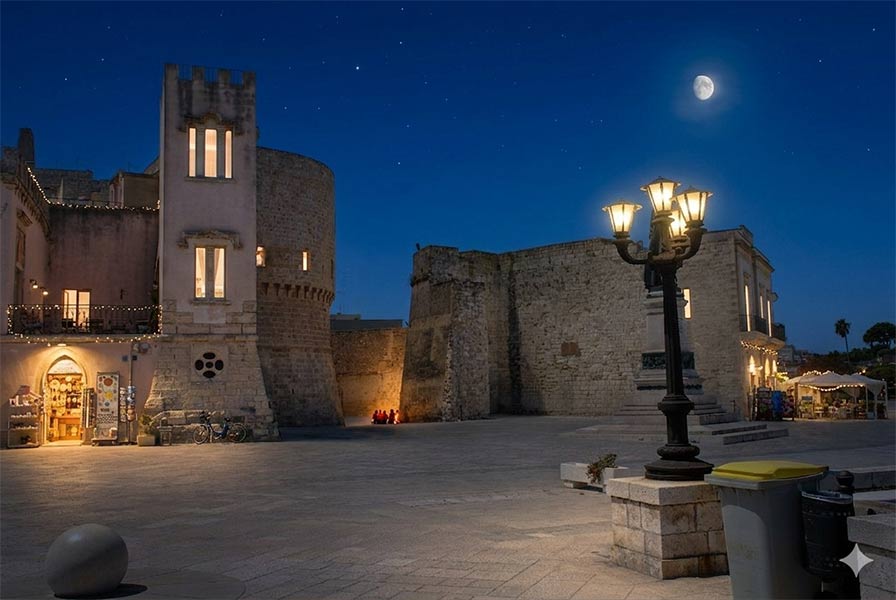
Castro has small coves and sections of coast that are best explored from the sea. Santa Cesarea Terme is known for an unusual mix of Art Nouveau and Moorish-inspired architecture. Otranto has Aragonese walls, a cathedral with an extraordinary medieval mosaic and traces of a Roman military harbour below sea level.
The point is not to choose the Adriatic instead of the Ionian. It is to choose it when you want a holiday that offers something beyond the beach itself.
Coastal towns: more than just a beach holiday
One of the defining features of this stretch of Puglia's Adriatic coast is the concentration of historic towns directly overlooking the sea. These are not inland villages a few kilometres from the beach: they are places built against the water, where walls meet the coastline, streets end at the harbour and history is visible at almost every turn.
Otranto, Castro and Santa Cesarea Terme
Otranto is the largest and best known of the three, with its historic centre, Aragonese Castle, Romanesque cathedral and vast twelfth-century floor mosaic, as well as a seafront that can be explored on foot.
Castro is smaller and more compact, with a medieval centre on a rocky spur and striking coves below. Santa Cesarea Terme is perhaps the most unusual: early twentieth-century Art Nouveau and Moorish-inspired villas rise around sulphurous springs that still feed the local thermal baths.
When to go: Puglia's Adriatic coast outside August
June and September are among the best months for the southern Adriatic coast of Puglia. In June the sea is already warming, the beaches are easier to enjoy and the towns are lively without being overwhelmed. In September the light becomes lower and warmer, the water reaches some of its highest temperatures of the year and the pace is noticeably slower.
July and August remain the busiest months, with all the advantages and complications of high season. Even then, however, some of the most beautiful stretches of the Adriatic coast require a little effort to reach - Baia dei Turchi is a good example - and that natural filter can help preserve a sense of place.
How to plan your holiday: choosing the right base
If you want to explore Puglia's Adriatic coast, your choice of base matters. Staying somewhere very isolated can mean using the car for every meal, walk or swim. Staying in a coastal town, with the sea within walking distance and other destinations reachable in less than half an hour, creates a very different rhythm: more spontaneous, less planned and more flexible.
Otranto as a starting point: what you can reach
From Otranto, Baia dei Turchi, the Alimini Lakes, Porto Badisco and Castro can all be reached by car in under thirty minutes. Santa Maria di Leuca - at the very tip of the heel, where the Adriatic and Ionian seas meet - and Lecce, the baroque capital of the area, are both within roughly an hour. Brindisi Airport is around 95 kilometres away.
This geographical, logistical and cultural position is what makes Otranto such an effective base for exploring Puglia's eastern coast. You do not have to arrive in Otranto and stay only in Otranto: you can use it as the starting point for the wider journey.
Villa Giulia Letizia is in Otranto's historic centre, 50 metres from the Adriatic. If you are planning a holiday in Puglia and want a base on the eastern coast, check availability for your stay.


Best Beaches near Otranto, Puglia: Which One to Choose and Why
Visitors who arrive in Otranto expecting a single beach discover something else instead: an entire coastline. Around twenty-five kilometres of Adriatic shore, each stretch with its own character - fine white sand, dunes backed by maritime pines, limestone coves and water that shifts from emerald green to deep blue depending on the seabed. Choosing where to spend a beach day around Otranto makes a real difference: it depends on what you are looking for, the kind of day you want, and how far you are willing to walk or drive from town.
This is not simply a list. It is a guide to understanding the Otranto coastline, for travellers who want to choose the right beach rather than follow the first recommendation they find online.
Otranto's Adriatic coastline: what to expect
The sea around Otranto is Adriatic, and that matters. The water tends to be cooler than on the Ionian side, but also clearer. The seabed slopes gradually in many areas, making it ideal for long swims. The north-easterly wind, known locally as the grecale, can bring waves on breezier days, but it also cools the beaches during the hottest hours of August. The colour of the sea changes almost theatrically throughout the day: grey-green in the morning, emerald around midday and cobalt blue later in the afternoon when the light is at its strongest.
The beaches around Otranto are not interchangeable. Each one has its own logic.
Baia dei Turchi: the beach that rewards a little effort
Baia dei Turchi is the best-known beach on the Otranto coastline and one of the most beautiful along Puglia's Adriatic coast, in the southern Salento area. The sand is exceptionally fine and pale, the water remains very shallow for many metres, and its colour moves seamlessly from transparent to bright turquoise. The name recalls the Ottoman landing of 1480: according to tradition, this was the bay where the troops came ashore before besieging and capturing Otranto.
The price of this beauty is access. The bay lies within a protected regional nature park and you cannot drive all the way to the shore. The final stretch is on foot, along a path through Mediterranean scrub. Travellers who do not want to walk may find it inconvenient. Those willing to make the short effort are rewarded with one of the few beaches in this part of Puglia that can still feel genuinely wild.
How to get there and when to go
You can park in the designated area and reach the bay on foot in around twenty minutes. The best time to arrive is early in the morning - before 10 a.m. - or in the late afternoon, when the light is softer and visitor numbers start to fall. In peak summer, especially around mid-August, even the early morning can be busy; arriving before 9 a.m. makes a noticeable difference.
The Alimini Lakes: where the sea meets the dunes
A few kilometres north of Otranto, the Alimini Lakes form a distinctive coastal ecosystem: two bodies of water - one brackish and one freshwater - separated from the sea by a system of wooded dunes and maritime pines. Alimini beach is long and wide, with pale sand that in places feels more like a northern European coastline than the Mediterranean. It is one of the few beaches on this part of Puglia's Adriatic coast where you can walk for a long distance along the shoreline without interruption.
Parts of the beach are served by beach clubs, while long stretches remain free and publicly accessible. The wind is almost constant here - an advantage on very hot days, but something to consider if you prefer perfectly calm conditions.
Alimini Grande and Alimini Piccolo
Alimini Grande is the larger brackish lake and the more visually dramatic of the two. Reeds and waterside vegetation, the flamingos that visit the area at certain times of the year, and the alternation of water and pine woodland create a landscape unlike anywhere else in southern Puglia. Alimini Piccolo is a smaller freshwater lake, quieter and less visited. The lakes are protected and are not open for swimming, but the nature trails around them are among the most pleasant in the area.
Porto Badisco: the bay of Aeneas
Porto Badisco is a small rocky bay a few kilometres south of Otranto, on the road towards Santa Cesarea Terme. This is not a sandy beach: expect smooth limestone, deeper water in an intense dark blue, and small hidden caves that can only be reached by swimming. Local tradition says that Aeneas stopped here on his journey towards Latium, one of the many foundation myths that are woven into the history of this corner of Puglia.
Porto Badisco is not for everyone. It is narrow, largely unserviced and especially popular with people who enjoy snorkelling and diving. The seabed can reveal surprises even close to shore. But for travellers looking for somewhere beyond the standard tourist route, with exceptional water and a quieter atmosphere that can be hard to find in August, Porto Badisco is one of the most rewarding options near Otranto.
Beaches in town: the convenient choice if you stay in the old town
Otranto also has beaches directly in town. They are small and often busy, but extremely convenient if you are staying in or near the historic centre and want to swim without taking the car. The Gradoni beach and the stretches near the seafront are among the easiest to reach. They may not have the dramatic scenery of Baia dei Turchi or Alimini, but they offer something more distant beaches cannot: the freedom to go for a swim and be back in town within minutes, several times in the same day.
People staying in central Otranto often use these beaches differently. They are not necessarily the main destination for the day, but a natural extension of life in town: a quick swim before lunch, or a dip in the evening after dinner. It is a rhythm that more distant beaches simply do not allow.
How to plan your beach days from Otranto: choosing the right base
Having a base in central Otranto changes the way you experience the coast. You can visit Baia dei Turchi early in the morning, return for lunch, rest during the hottest part of the afternoon and still take an evening swim a few steps from the harbour. Or you can devote one day to Alimini and the next to Porto Badisco, using Otranto as the point you leave from and return to.
That flexibility - being able to shape each day without being tied to where you are staying - is one of the practical advantages of choosing a base in town rather than farther inland.
Villa Giulia Letizia is in the heart of Otranto, 50 metres from the sea. The town beaches are within walking distance, while some of the most beautiful stretches of Puglia's Adriatic coast are only a short drive away. Check availability for your summer stay.
Villa with a Pool in Otranto: Stay near the Sea and the Old Town
Travellers who search carefully for accommodation in Otranto soon realise that finding the right combination is harder than it looks. Villas with pools do exist, but most are in the countryside, often ten or fifteen kilometres from the sea. Accommodation in the historic centre is plentiful, but it rarely combines a pool with enough space to feel substantially different from a conventional hotel room.
In this part of Puglia, the hospitality market often separates the two things: either you choose a pool and outdoor space, or you choose location. Finding both in the same place, inside Otranto and only a few steps from the Adriatic, is genuinely unusual.
Villa Giulia Letizia is one of those rare exceptions. And it is worth explaining why that combination can make a practical difference to the quality of a stay.
The trade-off travellers often face
Visitors who want to stay comfortably in Otranto often face an implicit choice. They can book a villa with a pool outside the centre - attractive, spacious and secluded - and use the car every time they want to see the old town, eat out or walk along the seafront in the evening. Or they can stay inside or close to the historic centre, where exploring on foot is easy, but give up some of the space and outdoor comforts of a villa.
That choice has a real cost, and not only a financial one. It changes the way you use the day. Stay outside and Otranto becomes somewhere you travel to. Stay inside and it becomes the place you are living in for a few days. The difference in the rhythm of the trip is substantial.
Inside the old town, 50 metres from the sea
Villa Giulia Letizia is in the heart of Otranto, only 50 metres from the Adriatic. The cathedral and Aragonese Castle are around five to ten minutes away on foot. The historic centre, seafront and restaurants around the harbour can all be reached without taking the car, planning a route or losing time in traffic.
In a market where many villas with pools are located in the countryside, this position is the first thing that makes the property unusual. But it is not the only one.
The accommodation: making space part of the experience
Villa Giulia Letizia offers deluxe rooms, junior suites and suites measuring between 50 and 60 square metres. In a hospitality market where that amount of space for a single unit is still unusual, size is not a minor detail. Each accommodation is organised into separate living and sleeping areas and includes Wi-Fi, a 55-inch television, minibar and kitchenette with an induction hob and oven.
The idea is closer to a residence than a conventional hotel room: the independence and space of an apartment, combined with the care of a hospitality property. For travellers staying for more than a night or two and wanting to feel at home rather than simply accommodated, that difference becomes noticeable very quickly.
Living area, sleeping area and veranda: the logic of an apartment
Each accommodation has a private veranda overlooking the garden or roof garden. It is not simply a small service balcony, but a space intended to be used as part of the stay. Early in the morning, before the heat of the day builds, the veranda is an easy place to have breakfast or sit outside. In the evening, it becomes somewhere to linger after returning from dinner.
The pool: a long stretch of water between the garden and the sky
The pool runs along the length of the property: long, regular and designed with a gradual depth and clean lines. Its light, natural-toned finish emphasises the clarity of the water and the sense of space. It is not simply decorative; it is made for swimming, cooling down and spending time outdoors without having to plan anything.
In the evening, the atmosphere changes. Integrated LED lighting, controlled through the property's home automation system, turns the pool into a different setting altogether - colourful, quiet and far removed from how it feels in the middle of the afternoon. It is the kind of detail that is difficult to plan for and easy to remember.
Staying in Otranto instead of simply visiting it
There is a way of experiencing Otranto that only becomes possible when you stay there for a few days. You can walk to the harbour early, before it gets busy, return for breakfast on the veranda, spend the hottest part of the afternoon by the pool, then head out again on foot in the evening and come back whenever you want.
That slower, freer rhythm is what a property such as Villa Giulia Letizia makes possible. Not because of luxury for its own sake, but because location, space and independence are rarely found together in the same accommodation.
Who is this combination really for?
For travellers who want comfort without giving up location. For people who have already visited this part of Puglia and now want to experience it at a slower pace. For guests who value privacy and space without being isolated from the town. And for anyone who would rather have their own kitchenette and veranda than depend entirely on shared spaces and fixed schedules.
Villa Giulia Letizia is not designed for every kind of traveller. It is particularly well suited to people who already know what they do not want and are looking for a combination the local accommodation market does not often provide.
Check availability for your stay in Otranto. The suites offer space for travellers who want somewhere to live for a few days - not just somewhere to sleep.